This Moosend Review covers one of the most value-dense email marketing platforms available for small and medium-sized businesses — a tool that has quietly built a strong reputation by doing something competitors routinely charge a premium for: making advanced automation accessible at entry-level pricing. Founded in 2011 in Athens, Greece, and acquired by Constant Contact in 2024, Moosend now serves over 100,000 customers worldwide with email campaigns, visual automation workflows, landing pages, and AI-powered features — all starting from $7 per month.
- Moosend Review: What is Moosend?
- Moosend Review: Key Features Breakdown
- Email Campaign Builder
- Marketing Automation — The Standout Feature
- Segmentation and Personalisation
- Landing Pages and Sign-Up Forms
- Analytics and Reporting
- Integrations
- Moosend Review: Pricing Plans Explained
- Moosend Review: Pros and Cons
- Moosend Review: How It Compares
- Moosend Review: Who Should (and Shouldn’t) Use it
- Moosend Review: Final Verdict
- Moosend Review: Frequently Asked Questions
If you are weighing up email marketing platforms and want an honest breakdown of what Moosend delivers and where it falls short, this Moosend Review covers everything you need to know before signing up.
30-day free trial · No credit card required · Plans from $7/mo
Moosend Review: What is Moosend?
Moosend is a cloud-based email marketing automation platform built to give small and medium-sized businesses access to advanced marketing tools without the premium price tag that has traditionally kept those features reserved for enterprise buyers. The platform covers the full email marketing cycle — campaign creation, audience segmentation, automated workflows, landing pages, sign-up forms, and analytics — in a single dashboard.
Its most significant milestone came in May 2021 when enterprise software company Sitecore acquired Moosend for over $200 million. In June 2024, Constant Contact acquired the platform from Sitecore, folding it into their ecosystem as their advanced automation engine for SMB customers. The backing of an established player like Constant Contact addresses the longevity concern that smaller email platforms often raise — Moosend is not going anywhere, and its infrastructure investment reflects that.
What sets this Moosend Review apart from most coverage: the platform’s core strength is not any single headline feature — it is the combination of automation depth and pricing. Marketing automation is typically a premium feature locked behind expensive plan tiers. Moosend includes it from the base plan at $7 per month.
Moosend Review: Key Features Breakdown
Email Campaign Builder
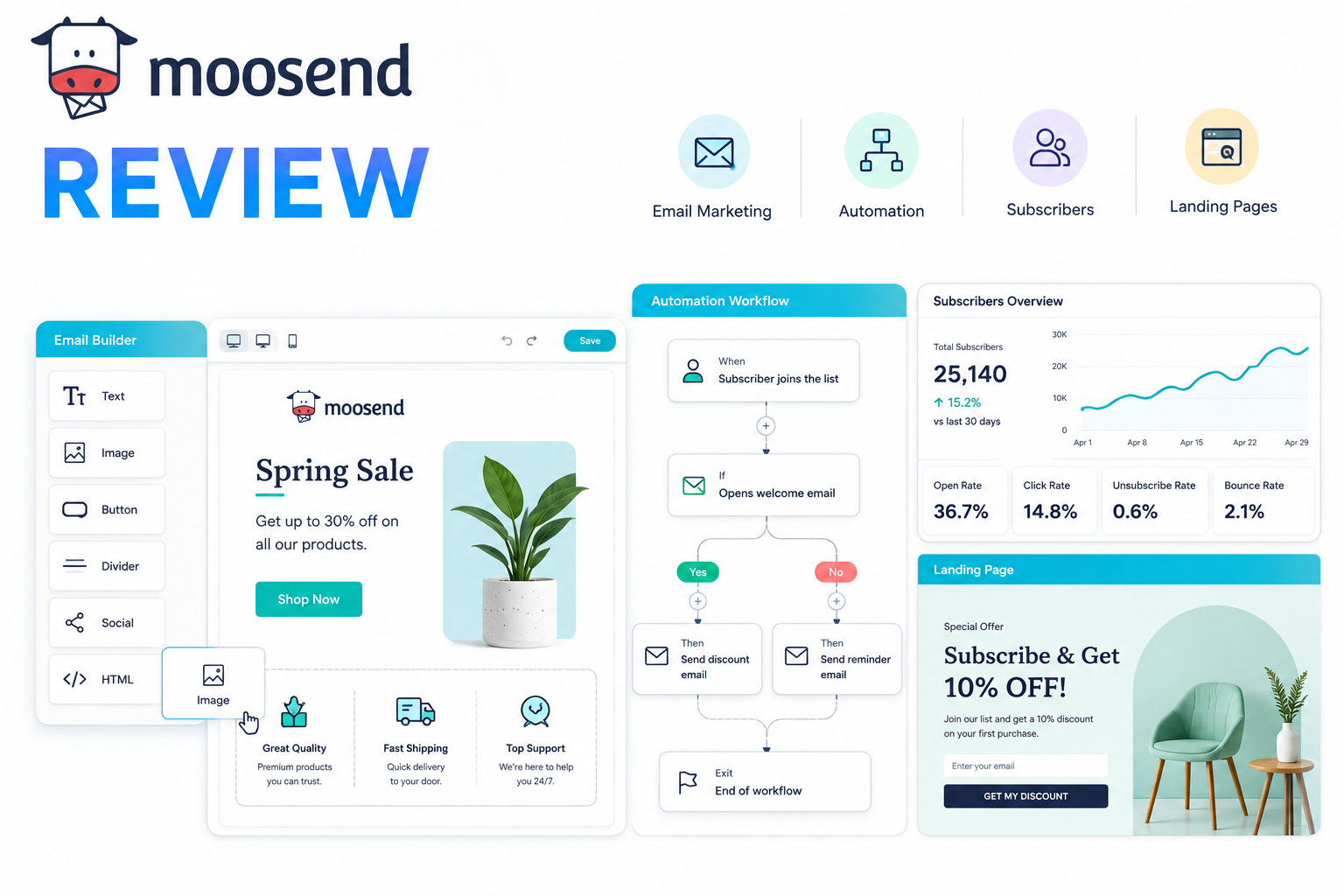
The drag-and-drop editor is clean, functional, and accessible to users without a design background. You can build responsive emails using pre-structured content blocks — text, images, buttons, dividers, product blocks, countdown timers, and social icons — without writing code. The editor provides live previews for desktop and mobile, and all templates are responsive by default.
The template library offers 115+ pre-designed templates covering newsletters, promotions, welcome emails, and seasonal campaigns. The designs are clean and modern, though the library is smaller than competitors like Mailchimp or ActiveCampaign. Some users report wanting more variety in the template selection — a reasonable observation, though the editor itself makes custom template creation straightforward enough that the library size becomes less important with familiarity.
Marketing Automation — The Standout Feature
This is where this Moosend Review finds the platform’s most compelling argument. The visual automation workflow builder is genuinely powerful, and — critically — it is not locked behind a higher-tier plan. Every paid plan includes full access to automation, which means a business paying $7 per month gets the same workflow builder as one paying $315 per month.
The builder supports multi-step conditional sequences triggered by subscriber behaviour: email opens, link clicks, website page visits, purchases, cart abandonment, form submissions, and custom events. You can add if/then branching, time delays, and conditional splits within the same workflow. Pre-built automation “Recipes” cover common use cases — welcome sequences, re-engagement campaigns, abandoned cart flows, upsell sequences — so you are not starting from scratch every time.
The honest limitation: some users report that automation triggers can occasionally behave unexpectedly, and the 30-day time limit on certain sequence types constrains longer nurture flows. For businesses running highly complex behavioural automation with multi-month timeframes, dedicated platforms like ActiveCampaign offer more sophisticated logic. For most SMB email marketing workflows, Moosend’s builder covers the use cases that drive actual results.
Segmentation and Personalisation
Moosend’s segmentation tools allow you to group subscribers by a broad range of attributes: demographics, past email behaviour (opens, clicks, bounces), website activity via tracking code, purchase history, custom fields, and subscription source. Segments update dynamically, so lists stay accurate without manual maintenance.
Dynamic content blocks let you show different content to different subscriber segments within the same campaign — a particularly useful feature for e-commerce businesses that want personalised product recommendations without sending entirely separate campaigns. The AI-powered product recommendation engine analyses subscriber behaviour and purchase data to suggest relevant products automatically.
Landing Pages and Sign-Up Forms
All Moosend plans include a landing page builder and a subscription form builder, which removes the need to pay for a separate landing page tool at the entry level. The landing page editor uses the same drag-and-drop approach as the email builder, with customisable templates for lead capture, webinar registrations, and product promotions.
For businesses focused on growing their list through content and organic search, having a built-in landing page builder is practical — though users who need advanced landing page functionality (dynamic text replacement, heatmaps, multivariate testing) will find the builder functional but basic compared to dedicated tools. The pages are optimised for search engine optimisation by default, with clean URL structures and customisable meta fields.
Analytics and Reporting
Moosend’s reporting dashboard covers the key metrics clearly: open rates, click-through rates, bounces, unsubscribes, and conversions. Beyond standard metrics, the platform includes a click heatmap showing which links in your emails get the most engagement, geolocation data on where subscribers are opening, and device/email client breakdowns. Campaign comparisons let you track performance trends over time.
Independent deliverability testing places Moosend consistently between 88% and 90.1% inbox placement — a solid but not industry-leading figure. The platform markets a 98% deliverability rate, though this reflects ideal conditions with clean lists and proper authentication (SPF, DKIM, DMARC). Moosend enforces strict anti-spam policies, which results in strong performance for senders with healthy lists but swift account suspension for those importing questionable contacts.
Integrations
Moosend offers 42 native integrations covering CRM tools (Salesforce, HubSpot, Pipedrive), e-commerce platforms (WooCommerce, Magento), CMS platforms, and lead generation tools. For connections not covered natively, Zapier extends integration reach significantly. The notable gap: Shopify integration requires Zapier rather than a direct native connection — a meaningful friction point for e-commerce businesses that picked Moosend partly to reduce tool sprawl. If you manage your business productivity through Microsoft Office tools, Moosend connects via Zapier rather than natively, which adds a dependency worth factoring into your setup.
Moosend Review: Pricing Plans Explained
Moosend’s pricing is based on subscriber count with unlimited email sends on all paid plans. The 30-day free trial includes full access to all Pro features, which gives you a meaningful window to test the platform before committing.
| Subscribers | Pro (monthly) | Pro (annual) | What’s included |
|---|---|---|---|
| Up to 500 | $9/mo | $7/mo | Unlimited emails, automation, landing pages, forms, A/B testing, reporting |
| Up to 2,000 | $24/mo | $19/mo | All Pro features |
| Up to 5,000 | $48/mo | $38/mo | All Pro features |
| Up to 10,000 | $88/mo | $70/mo | All Pro features |
| Up to 25,000 | $160/mo | $128/mo | All Pro features |
| Enterprise | Custom | Custom | Dedicated account manager, SSO, custom reporting, priority support |
One pricing reality this Moosend Review must flag: Moosend’s pricing scales with list size, not send volume. For businesses that send infrequently — one or two email blasts per month — the unlimited sends model works against you. You are paying for capacity you are not using. At larger list sizes (50,000+ subscribers), the monthly cost reaches $315+, which starts to close the gap with competitors that offer more advanced features at similar price points. The value proposition is strongest for businesses that send frequently to lists under 25,000 subscribers.
There is no permanent free plan — Moosend removed their freemium tier in 2022 and replaced it with the 30-day trial. If a free-forever option is a requirement, you will need to look at alternatives like Mailchimp or MailerLite.
Moosend Review: Pros and Cons
- Advanced automation included on all paid plans from $7/mo
- Unlimited email sends on every plan
- Visual workflow builder with pre-built automation Recipes
- AI-powered product recommendations built in
- Landing page and sign-up form builder included — no extra tool needed
- Click heatmap and geolocation reporting
- 88–90% deliverability with clean lists
- 30-day free trial with full Pro feature access
- Backed by Constant Contact — reliable long-term infrastructure
- Up to 40% lifetime recurring affiliate commissions
- No permanent free plan — trial only
- Shopify integration requires Zapier — no native direct connection
- Only 42 native integrations — smaller than most competitors
- No SMS or push notification channels
- Template library limited to 115+ designs
- No dedicated mobile app — mobile web experience only
- Pricing scales steeply for large lists (50K+ subscribers)
- Some automation triggers reported as inconsistent
- No phone support on standard plans
Moosend Review: How It Compares
| Feature | Moosend ✅ | Mailchimp | ActiveCampaign | MailerLite |
|---|---|---|---|---|
| Starting price (500 subs) | $7/mo | $13/mo | $15/mo | $9/mo |
| Free plan | 30-day trial only | ✅ Yes | ❌ No | ✅ Yes |
| Automation on base plan | ✅ Full access | Limited | ✅ Full access | Basic only |
| Unlimited email sends | ✅ All plans | Send limits apply | ✅ Unlimited | ✅ Unlimited |
| Landing pages included | ✅ All plans | ✅ Yes | ✅ Yes | ✅ Yes |
| Native Shopify integration | ❌ Via Zapier only | ✅ Native | ✅ Native | ✅ Native |
| SMS / push channels | ❌ Email only | SMS add-on | ✅ SMS included | ❌ Email only |
Moosend Review: Who Should (and Shouldn’t) Use it
In this Moosend Review, the ideal user profile is clear — and the cases where a different platform will serve you better.
Moosend is the right choice for:
- Budget-conscious SMBs and solopreneurs who need automation beyond basic autoresponders without paying the premium that ActiveCampaign or HubSpot charge
- Businesses that send frequently — the unlimited sends model rewards high-frequency senders significantly more than per-send pricing models do
- Content marketers and bloggers running newsletter-style campaigns with straightforward automation (welcome sequences, re-engagement flows, lead nurturing)
- WooCommerce store owners — the native WooCommerce integration is well implemented with product recommendation and abandoned cart tooling built in
- Teams stepping up from basic tools like Mailchimp who want advanced automation without triple the monthly cost
Moosend is the wrong choice for:
- Shopify stores — the absence of a native Shopify integration is a genuine operational friction point. Klaviyo and Omnisend both offer deep native Shopify connectivity and e-commerce-specific automation that Moosend cannot match
- Multi-channel marketers who need SMS or push notifications alongside email — Moosend is email only
- Large lists sending infrequently — if you have 50,000 subscribers and send monthly, you are paying $315+ for unlimited sends you are not fully using
- Teams requiring phone support — Moosend’s support model is live chat and email, with Enterprise being the only tier that adds a dedicated account manager
Moosend Review: Final Verdict
To summarise this Moosend Review: the platform delivers exceptional value for its target audience: small and medium-sized businesses that need automation-driven email marketing without paying enterprise-level prices. At $7 per month with full automation access, unlimited sends, landing pages, and segmentation included, Moosend competes directly with tools that charge two to three times more for comparable functionality.
The gaps are real — no native Shopify integration, no free plan, no SMS channel, a limited template library, and no mobile app. But for a business whose email marketing needs sit within Moosend’s sweet spot (regular campaigns, behaviour-based automation, list growth through landing pages), none of those gaps materially affects the core workflow.
The Moosend Review recommendation: use the 30-day free trial with real campaigns and real subscriber data. The platform’s strengths — particularly the automation builder and deliverability — reveal themselves through use rather than through a feature checklist. If those hold up against your actual workflow, you will be getting more capable email marketing software than the price suggests.
All Pro features included · No credit card required
Moosend Review: Frequently Asked Questions
This article contains affiliate links. We may earn a commission if you purchase through our links, at no extra cost to you.